Solo Exhibition On View at The Shelburne Museum

Porcelain Love Letters: The Art of Mara Superior

“Artist Mara Superior has a deep love for porcelain—a dedication that compels he to work with this ancient and often unpredictable material. She works with slab construction and fires her pieces in a high-temperature reduction atmosphere, techniques that make the process even more challenging and increase the risk of warping or breakage.

Trained as a painter, Superior discovered the beauty and creative possibilities of porcelain in the late 1970s. Since then, she has focused entirely on this bright but delicate material, appreciating both its fragility and its strength. She describes porcelain as a “magical three-dimensional canvas,” where she carefully paint detailed, whimsical images and adds sculptural designs to create pieces that are both visually striking and rich with meaning.

Superior’s art draws inspiration from many sources, including Ancient Egyptian hieroglyphics, illuminated manuscripts, Renaissance art, historical ceramics, and Americana. She blends these influences to create her distinctive and romantic style. Each piece feels like a love letter to the world—reflecting her deep affection for home, good food, the environment, and her country.

This exhibition showcases a wide range of Mara Superior’s work, from her early explorations to her latest creations. It features commissioned pieces from private collections along with deeply personal works from her own home—many of which have never been show before. Superior considers the works on view here some of her most treasured pieces, demonstrating both her artistic skill and creative imagination.”

—Kory Rogers,
Francie and John Downing Senior Curator of American Art, Shelburne Museum

ABOUT MARA SUPERIOR

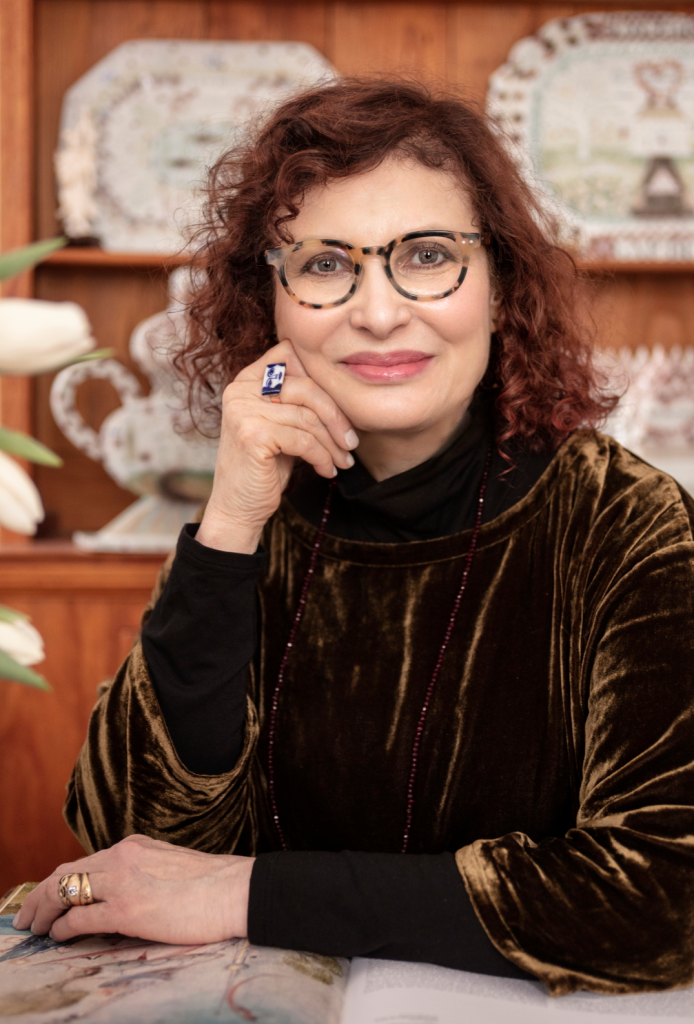
Mara Superior is an American visual artist who works in porcelain. Her ceramic high-relief platters and sculptural objects reflect the artist’s passion for art history and the decorative arts, and her painterly motifs range from the pleasures of the domestic to serious political and environmental issues as points of departure to comment on contemporary culture and its relationship to history. Superior has received numerous awards including a National Endowment for the Visual Arts Fellowship, the prestigious Guldaggergård Residency in Denmark, and numerous individual artist grants from the Massachusetts Cultural Council. In 2025, Mara will feature recent and selected masterworks from her archives and private collections in her solo show, Porcelain Love Letters: The Art of Mara Superior at Shelburne Museum (Shelburne, VT). 

Superior has exhibited at the American Museum of Ceramic Art (Pomona, CA), Scripps Women’s College (Claremont, CA), and the Fuller Craft Museum (Brockton, MA), among many other institutions. Her work can be found in the Renwick Gallery of the Smithsonian American Art Museum (Washington, DC), the Museum of Arts + Design (New York, NY), the Peabody Essex Museum (Salem, MA), Philadelphia Museum of Art (Philadelphia, PA), the Los Angeles County Museum of Art (Los Angeles, CA), and White House Collection of American Craft (Little Rock, AK). In 2018, through the generous support of the Kohler Foundation, gifts of art by Mara Superior were made to fifteen museums throughout the USA, increasing the public holdings of Superior’s artworks and including an in depth collection acquired by the Racine Art Museum (Racine, WI) and shown in 2020 in Collection Focus: Mara Superior. In 2010 she was interviewed for the oral history program of the Smithsonian’s Archives of American Art (Washington, DC).

Superior studied at the Pratt Institute and Hartford Art School, completing her BFA in painting from the University of Connecticut in 1975 followed by a MAT in ceramics from the University of Massachusetts Amherst in 1980. She is represented by Ferrin Contemporary.
more on mara
STATEMENTS FROM THE ARTIST
ON ART HISTORY

“My passion for Art History and the History of the Decorative Arts has informed my work throughout my career. I seek to create beauty through the reinterpretation of historical inspirations synthesized with my own visual vocabulary and contemporary views. The resulting objects are rooted in the historical continuum.”

ON HER PAINTING BACKGROUND

“At 26 years old, I came to porcelain and brought to this new material all of the tools and accumulated knowledge from my background, education, and experiences to date. My undergraduate background in painting shaped who I am as an artist—the way I see and think visually and conceptually. I approached ceramics from a two-dimensional point of view, with platters being canvases.

I was attracted to porcelain as a painting surface. My preference for slab building, akin to 3- dimensional construction paper, is because it is a flat, smooth painting surface. I came with content and imagery in mind. I explored strong shapes and construction methods, and I settled on a boxy construction format which could accommodate curves. I explored flattening iconic ceramic vase and teapot forms. Form and surface were coming together for me, and then I had a new element to work with—texture! Stamping sprigs and modeling were incorporated into the designs.

First, I always make sketches of ideas in sketchbooks. I begin by drawing shapes on paper of objects that I wanted to try to build in porcelain. When the shape is perfected, my sewing skills come into play with pattern making for porcelain constructions. I make vellum patterns and trace them onto leather hard slabs of clay, cut out the parts, and assemble the sculpture.

I went back to school specifically to study ceramics after a five-year interim period. It was a tiny department of two professors, but since my roots were already in place, I wasn’t able to take off and select the best ceramic program in the nation. I had to make do. It all worked out in the end.”

ON PORCELAIN

“With porcelain, the material comes with a world of historical context of its own. I’m interested in working with a clay body with a history attached to it—either porcelain or terracotta. When I’m holding porcelain in my hand, I feel like I have a 1600-year-old continuing link to the original Chinese porcelains that were developed around 400 A.D. The material and firing method that I have selected—

high fired porcelain in a reduction fired kiln—refer back to this ancient history and are comparable to what was produced in 400 A.D. I am on that continuing timeline, and that’s part of the thrill and excitement of working with porcelain.
As I’ve said, there are lots of problems with this material, but I knew from the start that this is what I wanted. I got stuck on this particular material and firing method because I saw it from its historical vantage point and because maybe my visual acuity is more discriminating than most. Other people might not be able to distinguish between a lower fire soft paste porcelain, which I see as warm and pasty, and the depth of this glassy porcelain that I use. This material excites me to this day.

I don’t know anyone that has done what I have done with these exact materials. It’s not because I’m stupid—it’s because I’m stubborn. I do know what is possible and I’m always after what is in my mind’s eye. When I’m working, I’m seeing the best firing. I’m seeing the copper doing its thing. Sometimes I’m disappointed, because that’s a whole other world of things, working on something for months and then putting it in a kiln with unexpected results. Even though you’re trying your best to control the atmosphere, unexpected things might happen during the kiln firing. It’s a tremendously high-risk material, and I guess I have the patience for it. Creative energy is creative energy, and it can be channeled into anything, any material.

When I was younger, I experimented with many materials, and sometimes I would work with a few materials at the same time. But I came to recognize that I had to choose one, and it seemed to come down to what I had the patience for. I discovered this porcelain by chance, and that was it. I just loved it at first sight, and I was sticking with it.”
First, I always make sketches of ideas in sketchbooks. I begin by drawing shapes on paper of objects that I wanted to try to build in porcelain. When the shape is perfected, my sewing skills come into play with pattern making for porcelain constructions. I make vellum patterns and trace them onto leather hard slabs of clay, cut out the parts, and assemble the sculpture.

I went back to school specifically to study ceramics after a five-year interim period. It was a tiny department of two professors, but since my roots were already in place, I wasn’t able to take off and select the best ceramic program in the nation. I had to make do. It all worked out in the end.”

ON HER AESTHETIC

“My work is autobiographical. Whatever is at the top of my mind can find its way into my work. It’s a visual diary of my “One Life Story”. Ultimately, my work is about humanity and about being alive as a human being in my time. It’s the life story of my voice in porcelain.

Upon encountering the American minimalist artist Robert Ryman, best known for his monochromatic white canvas paintings made during the mid-1970s and early 80s, art critics of the day wrote in Art Forum magazine that “Painting is Dead”. I thought that this could not possibly be true! There would always have to be room for what I termed as “personalism”, as a human artistic expression. I think that this closely relates to the currently popular “identity”- based painting.

During this time, the fine art world was quite hostile towards object makers, and the craft world was all embracing. It was a kinder, gentler community of individuals (though of course, less intellectually brilliant in the hierarchical order of things in the art world). Many artists crossed over at this time, and the craft world inherited “object makers” because they were celebrated.

My work has always been celebratory, commemorative, idealistic, uplifting, and beautiful. That hasn’t changed over the years, whether I’m working with romantic or controversial political subject matter. From the start, I set out to make beautiful objects with their “messages” to send out to the world, and I’ve done that. They are precious objects, meant for the joy of observation and calling out for ceremonial placement in the environment. They were never really intended to be utilitarian, although, of course, I use my pieces. I have great esteem for functional potters, who must use very practical considerations—ergonomics, how objects work and feel in the hand and on the lips, the weight and balance of things—as well as good design.

A few of the subjects that have inspired me over the years are the history of porcelain and ceramics; history, art history, and mythology; mates for life, romance, big love, and pairs; house, garden, and all things domestic; botanicals and still life; feminism, female icons, and the domestic goddess; food and the history of food; farm animals, pets, and wildlife; love letters to New England architecture, landscape, and sense of place; the sea, fantasy, and aqua vitae (“water of life”); travels, souvenirs, Europe, and museums; music and books; political commentary; the environment; and collections. Now that Biden is in office, I feel that I can get back to my own artistic content—for two years, anyway. There are endless topics of inspiration. I have sketchbooks filled with ideas for things that I haven’t made yet. At this point I don’t think about it—I just do it.”

ON HER CAREER

“I was nurtured and encouraged to develop my imagination by my family and art teachers all the way through graduate school. Further enrichment came by way of my extraordinary good fortune to have been married to Roy Superior, a wonderful Artist and Professor of Art. Over the course of my career, ceramics, art schools, museum curators and society have evolved to become more inclusive. Barriers have

disintegrated, and currently, it feels as if ceramics is female-empowered given that so many of the magazine editors, gallerists and many curators are women. For my entire professional career, I have been blessed to have only one brilliant and visionary female art dealer, Leslie Ferrin, of Ferrin Contemporary. Leslie has always encouraged my best work, offered me opportunities, and given me valued professional advice. The choices that I employ regarding my own work for materials, content, palette and ornament might, by historical standards, be considered feminine work by nature. That label has never been a hindrance to me. I have had a very privileged life and career as an artist and am grateful for it all.”
STATEMENTS ABOUT THE ARTIST
REVIEW BY ANGELA FINA IN AMERICAN CERAMICS MAGAZINE

Mara Superior’s pieces are vessels of memory, powerful forms filled with a remembrance of things past. They are commemorative icons expressing a hieratic spiritual quality that calls for ceremonial placement in the environment. The content of the drawings is contemplative and complex, and the use of words gives clues to the paradox being explored.

Superior has chosen to flatten certain historically evocative pot forms to give the kind of boundaries that spherical shapes do not have, creating a shaped canvas for drawings. The forms are instantly recognizable, but they are exaggerated. Curves sometimes become angles, lids are miniature repetitions of the same pot form, lids often have lids, and the foot can become a separate pedestal. The pieces have a trophy-like presence that comes from their frontal, pedestaled presentation and from the content of the narratives drawn and written on the surface. The optical quality of the reduction-fired, clear-glazed, white porcelain is an important sensual part of Superior’s work. She explores and exploits many self-referential ceramic themes, including that of the permanence of fired clay. The formal, deliberate, and over-sized pieces are made to last centuries. She also deals graphically with the traditional relationship of pottery form to human body parts. There are animal references, such as swan-neck teapot spouts with beak openings. She uses the shapes of historically evolved pots and, despite the flattened and monumental size of her pieces, each is carefully made to be functional. Vases can hold a bouquet, and their function is celebrated and explained in the drawings on their surfaces. Superior’s work is firmly grounded in ceramic tradition; the ancient Greeks, too, decorate their ceremonial pots with narrative drawings. The fascinating physical beauty of glazed porcelain, with its copper-red blushes and floating cobalt blues, is of central value in these pieces. They could not exist with the same impact in any other material. They are about ceramic art. The quality and content of the drawing conjures memories of illuminated manuscripts, with their house portraits, pastoral scenes, textile patterns, and small botanical studies. The drawings, mostly inspired by Superior’s New England environment, also have the graphic quality of an embroidered sampler, with an earnest, deliberate pace that precludes cuteness. There is a very personal and idiosyncratic quality in Superior’s work that co-exists with a great strength and dignity. The work appears not to be influenced by current fashions in drawing and painting or by such hot trends as brightly colored, low-fire clay art. A unique freshness emerges from the artist’s almost cloistered, confident, personal vision.
DIRECTOR NOTES FROM NATURE/NURTURE EXHIBITION

In the works presented in Nature/Nurture, Superior’s political views are expressed front and center. The large-scale porcelains use the format of Renaissance-era storytelling platters with wide-rimmed borders functioning as frames. Carefully placed medallions and miniature objects in relief are emblazoned with messages delivered in delicately, hand-painted, calligraphic, heavily-laden serif fonts. Whether

she is channeling mother nature or calling on higher powers to impact the coming election, Superior speaks loudly in large, all caps type, using the language of decorative arts to shout her beliefs in beauty and humanity’s inherent goodness.
Originally a New Yorker, Mara has been living and working in Western Massachusetts since the 70’s. Her life and work are an ode to Western culture. While embracing traditional values of home and beauty, her work is from a modern perspective with a feminist nod to sensuality and pleasure. Whenever possible, she spends leisure time wandering the museums of the world– in person. But, now, quarantined at home, she is touring these museums virtually, attending online classes, watching zoom lectures, and enjoying her vast library of gorgeous art books. She shares these moments along with the slow progress of painting her next work All American on her Instagram feed.

Superior met Leslie Ferrin at the beginning of her career. Both were in school, Mara at UMASS in the MAT program, Leslie at Hampshire College. Mara’s husband, Roy Superior, was Ferrin’s professor. They shared studios as artists, founding Pinch Pottery in Northampton, followed by East Street Clay Studios (Hadley, MA). Their intertwined, four-decade-long careers have weathered many changes and challenges over 40 years. Roy passed away in 2013, truly a renaissance man, an artist, sculptor, musician and beloved professor for 40 years spending 16 years at the University of the Arts in Philadelphia. Mara continues to live in the New England farmhouse they slowly renovated together, surrounded by the furniture he built to hold her works, his drawings, their library and his “wunderkammer” collections. The studio filled with hand made, hand tools, is still intact.

Superior’s artwork features ideas gleaned from research and travel, uniting all her interests in thematic approaches to specific content. Like her exuberant country garden, her work is always a beautiful mix of heirlooms and hybrids, free-ranging and grafts that come from strong rootstock. Her mashup mix of source material is delivered as stylized interpretations through images and didactic text. Using a combination of folk traditions, references to the classics of Western art, she infuses not so veiled socio-political messages from a contemporary perspective. Her deep love of ancient Greek, Roman, Asian antiquities, European and Early American pottery and ceramics – these objects become the subject matter of collection platters that feature miniature versions of her coveted favorites.

Read more about Nature/Nurture